

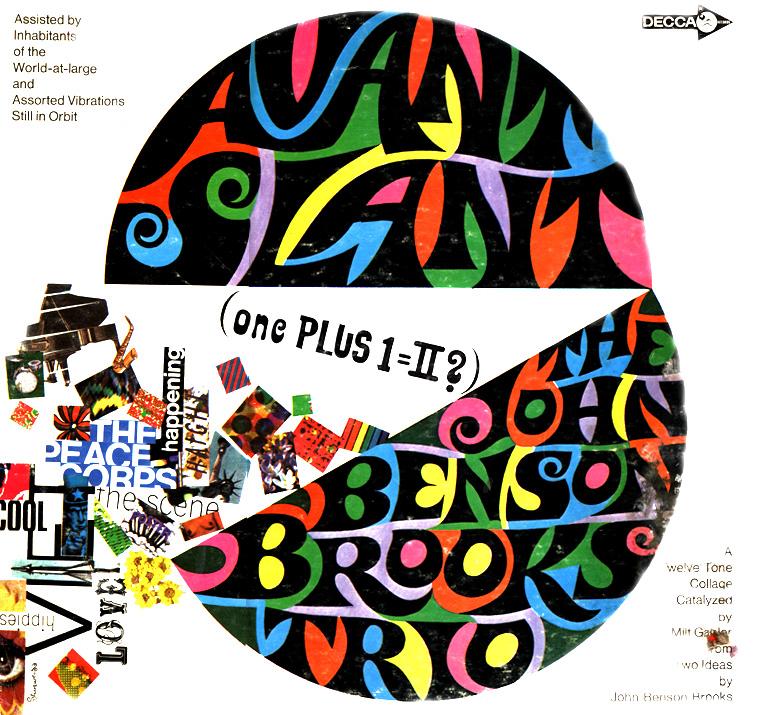
I was 19 when Woodstock happened. By then though, I was listening to Jazz. I missed the Beats by a few years. Avant Slant is an aural chronicle of the 1960's. "Catalyzed" by Milt Gabler, this 12 tone collage has not been released on CD.

It speaks to my soul.

Download Side One ADownload Side One BDownload Side Two ADownload Side Two B

AVANT SLANT (one PLUS I = II?)

A Twelve Tone Collage

THE JOHN BENSON BROOKS TRlO


assisted by inhabitants of the world at large, and assorted vibrations still in orbit.

Catalyzed by MlLT GABLER from two ideas by John Benson Brooks special material by Milt Gabler

An Original Music Corporation Production


THE MUSICIANS:

The John Benson Brooks Trio: John Benson Brooks, piano; Don Heckman, alto sax; Howard Hart, snare drum and cymbal.


THE ACTORS:

JOYCE TODD, HERB HARTIG, ERNlE STONE, JACK GlBSON


Side One CONTENTS


1. The King Must Go (segments) (J. B. Brooks) ASCAP

JOHN BENSON BROOKS TRlO

The Gods On High (Milt Gabler. J. B. Brooks)

JUDY SCOTT

Pie in The Sky (Milt Gabler, J. B. Brooks) ASCAP

THE RlTES

No Man Is An lsland (excerpt) (John Donne) 1624

El Bluebirdo (John Benson Brooks) ASCAP

BENSON BROOKS QUARTET

“Autobiography" (excerpts) (Lawrence Ferlinghetti)

A Bird Can Be (Milt Gabler)


2. Cherries Are Ripe (segments) (J. B. Brooks) ASCAP

JOHN BENSON BROOKS TRlO

What's A Square? (Milt Gabler, J. B. Brooks)

JUDY SCOTT

Slapstix-(Jack Shaindlin) BMI

JACK SHAINDLIN-Piano Solo

"Autobiography" (excerpt) Lawrence Ferlinghetti)

True Blue Heart (Jack Shaindlin) BMI

JACK SHAINDLIN-Piano Solo

Little Boxes (excerpt) Malvina Reynolds ASCAP

THE TARRlERS

But, Where Are You? (Milt Gabler, J. B. Brooks) ASCAP

JUDY SCOTT


Side Two


1. Ornette (segments) (John Benson Brooks) ASCAP

JOHN BENSON BROOKS TRIO

"The People Yes! (excerpt) (Carl Sandburg) 1936

"The Magical Underwear Panty (with Detachable garters)" (excerpt)(Seymbur Krim) 1941

“Give Me Your Tired" (excerpt) (Emma Lazarus) 1887

“Love is Psychedelic (Milt Gabler, J. B. Brooks) ASCAP

JUDY SCOTT

"The People, Yes" (excerpt) (Carl Sandburg) 1936

The Llfe I Used To Live (Lightning Hopkins) BMI

LIGHTNING HOPKlNS

When I First Came To Town (p.d.)

Mend Them Fences (Robert Graves, J.B. Brooks) ASCAP

JOHN BENSON BROOKS

But, Where Am I (Milt Gabler, J. B. Brooks) ASCAP

JUDY SCOTT


2. Satan Takes (segments) (John Benson Brooks) ASCAP

JOHN BENSON BROOKS TRIO

Pie in the Sky (Milt Gabler, J.B. Brooks) ASCAP

THE RITES

“America, The Beautiful” (except) (Catherine Lee Bates) 1893

We Shall Overcome (fragment) BMI

(Zilphia Horton-Frank Hamilton-Guy Carawan-Pete Seeger)

"The Tree of Liberty" (excerpt) (Thomas Jefferson) 1787

"Black Dada Nihilismus" (excerpt) LeRoi Jones)


ACKNOWLEDGMENTS


"On Location" Sounds recorded by Robert and Joan Franklin

A Special thank you to Sammy Davis Jr. for his permission to use part of his "Town Hall Concert", also

To Jack Shaindlin for his piano solo portions from "50 Years of Movie Music", and

To The Tarriers for “Little Boxes" (words and music by Malvina Reynolds) © Copyright 1962, Schroeder Music Co. (ASCAP), used by permission

"The Magical Underwear Panty (with Detachable Garters)" © 1941 by Seymour Krim-from "Views of a Near-Sighted Cannoneer" published by E. P. Dutton

“Autobiography" by Lawrence Ferlinghetti-from A Coney Island of the Mind ©1958 by Lawrence Ferlinghetti. Recorded by permission of New Directions Publishing Corporation.

“The People, Yes" by Carl Sandburg.

Copyright 1936 by Harcourt, Brace and World, Inc. Renewed 1964 Recorded by permission of Lucy Kroll Agency.

“ Black Dada Nihilismus"- by LeRoi Jones.

Copyright © 1964 by LeRoi Jones with his permission.

"The Life I Used To Live" by Lightning Hopkins by permission of BELL RECORDS, INC


Engineers: Rudy May, Emil Korsen, Joseph Curran George Chandler

Editing Supervision: Milt Gabler


AVANT SLANT is a collage-in-sound, in which fragments of poetry, pop tunes, radio broadcasts, and Feiffer-like babble intermingle to form an aural history of "Right Now." It is also a twelve-tone: jazz concert, an electronic poem composed in several media, and the first example of what may be a radically new art form. It resulted from a unique collaboration between a creative artist and a technical wizard. The artist is John Benson Brooks, composer, arranger, pianist, and philosopher-a distinctly original man, who manages to enlarge everyone who comes in contact with him. The wizard and catalyst is Milt Gabler, without whom the library of recorded music in America would be woefully, even irreparably smaller, as his biography makes all too clear.

The record had its beginning a few years ago when Brooks played two tapes for Gabler. The first was a performance by the John Benson Brooks Trio, recorded on June 2, 1962, at the International Jazz Festival held at Howard University in Washington, D.C. Since 1959, Brooks had been working with Don Heckman and Howard Hart on the problems of improvising jazz in the twelve-tone serial and chance idioms, and this tape constituted the Trio's public debut, and (as it turned out) its final performance as well. The second tape was a curious melange of air-shots, record-excerpts, sound-effects, and oneliners that Brooks had put together, more or less experimentally, under the generic title, D. J.-ology.

On first listening, the two tapes seemed to have little relation to one another, but it soon became evident to Gabler that a connection did exist. The same sensibility had shaped them both, and each described, from a different angle, a similar vision of the world. Gabler suggested that they might be intermixed to form a large, many-levelled work, and after months of collaboration in studio and workshop this record has emerged.

`AVANT SLANT is not a mere documentary in sound, a sort of "Sounds: Of Our Times" narrative, but a full-fledged creation of its own, in which music reverberates against words, and words reverberate against music, with a single, controlling intelligence as the point where they converge. The four self-contained jazz improvisations of the Trio are here as originally recorded, except that they have been broken up to form the context in which the other material is arranged, providing a comment on it, an elucidation, and an overall artistic structure. All by themselves, The Twelves (as Brooks calls these works) are intensely fascinating, and twelve-tone aficionados will want to tape them in sequence off this record so that they can hear the original twenty-minute concert as it was presented in Washingon. For others, AVANT SLANT offers a compact anthology of John Benson Brooks and Milt Gabler songs-mordant, insinuative, wryly humorous lieder of our time that take on new relevance, and new poignance, now that they are placed in the context of the contemporary, non-musical sounds out of which popular music has always come. One of them, by the way, has lyrics by world-famed poet Robert Graves, whose collaboration on an American pop-song is an event by anybody's standards.

For everyone, this record will be a new kind of listening experience, one that gets richer each time around, as its themes surface and fade and re-surface via the ironic juxtapositions and violent wrenches of context that Gabler's interpolations and creative editing have made possible. Here are the ghost-voices of such contemporary oracles as LBJ, ex-Governor Wallace; and perhaps Dean Martin, and Everett Dirksen-not to mention a host of other, more tentative voices that might very well be yours or mine. Here are echoes of the identity crises, war, space-fantasies, racism and anxiety that haunt all our lives today. And here, as well, is that black humor which is so often our last defense against the confusion and sheer noise of a technological civilization that seems increasingly to measure its nerves in decibels. And woven through it all, the surge and eddy of this challenging music provides that coherence which art alone can shape out of the chaos of modern experience-a kind of non-verbal Chorus that is particularly eloquent in a word-buffeted time.


Hear it now.


JOHN CLELLON HOLMES Author: "The Horn", "Nothing More To Declare", and others.


DL75018

DECCA STEREO


BlOGRAPHlCAL lNFORMATION


HOWARD HART, Drums (snare and cymbal only on this LP). Born in Ohio. His poetry has appeared in the Saturday Review of Literature and other magazines; he was for a while poetry editor of Exodus, a literary quarterly, and has published a book of poems, The Sky of Orange Whispers. He has also written for the theatre; Deep Evil, Revenge On Little Orphan Annie, and Noontide, a translation and adaptation of Claudel's,- Partage de Midi, appeared off-Broadway, and was highly praised. Hart studied drums with Kenny Clarke and composition with Charles Mills.


DON HECKMAN, Alto Sax. Born in Florida and educated at Florida State University where he received a B.A. in music theory, Don Heckman has also studied composition with Dohnanyi and John Cage; alto with Lee Konitz. He has also written jazz articles and criticism for Down Beat, Metronome, American Record Guide and conducted his own jazz record show on WBAI. More recently, he has written scores for a number of TV films and off-Broadway shows and, at present, has an lmprovisational Workshop with Ed Summerlin.


JOHN BENSON BROOKS, Piano. Born in Houlton, Maine, John Brooks studied at the New England Conservatory of-Music with George Cohen, Josef Schillinger, and later, after a stint as arranger for big bands and successful songwriter, with John Cage. He arranged for Les Brown, Tommy Dorsey, and Randy Brooks, among other bands, from 1943-1947. Some of his best-known songs are, "You Came A Long Way From St. Louis," "Where Flamingos Fly," "Over The Weekend" and "Just As Though You Were Here," and he's had two LP's, Folk-Jazz USA and Alabama Concerto. His electronic composition, "Bird Meets Cage," was performed over WBAl in January 1961.


MlLT GABLER, Artists and Repertoire, song-writer member of A.S.C.A.P. since 1947, and Decca Records executive since 1941. He has produced recordings by many of the most important performers in the world. A jazz recording pioneer (having founded the famous Commodore label in 1938), he was the subject of a two-part profile in the New Yorker magazine in March 1946. He has continued his work at Decca and is currently engaged in re-issuing the classic jazz recordings from the Decca library in its "Jazz Heritage Series."


JUDY SCOTT, Singer. Born in Durango, Colorado, she was discovered at 17 by Ralph Flanagan when he heard her sing the lead in a summer stock performance of South Pacific. She toured with the Flanagan band for a year, then joined the Jerry Lewis troupe playing the Sands Hotel in Las Vegas, Chez Paree in Chicago and Fountainbleu in Miami Beach, as well as taking part in Jerry Lewis' TV spectacular. Other TV appearances include the Ed Sullivan, Jack Paar, Merv Griffin and Johnny Carson Shows; and she has taken her own night club act to most of the major clubs in the U.S. from the hungry i in San Francisco to the Copacabana in New York.


Posted December 24, 2005


Return to Additional Thoughts












































